
AI adoption in CMMC regulated environments is one of the fastest ways to create compliance exposure your assessor will find and one of the most misunderstood opportunities for operational advantage. Before your organization spins up a new tool or rolls out a policy, there are a few things executives at DIB contractors need to understand.
Key Takeaways
- Any AI tool that touches CUI is inside your CMMC assessment boundary, whether you planned it that way or not.
- AI governance in a CMMC environment isn’t a separate workstream.
- Separating AI tools by use case is one of the best ways to adopt AI without expanding your compliance scope.
Table of Contents
The Problem: AI tools Expand Your CUI Boundary
Most AI tools create problems for defense contractors because no one asked the right question before deployment:
Does this tool process, store, or transmit CUI?
Under CMMC Level 2, any system that touches CUI is in scope for your assessment. That includes AI platforms, large language model (LLM) APIs, and productivity tools with AI features built in.
If your team is using a general-purpose AI assistant to draft proposals, summarize contracts, or analyze technical documents, and that tool is cloud-hosted with data retention enabled, you may have just expanded your CUI boundary without realizing it.
The DoD CIO’s AI Cybersecurity Risk Management Tailoring Guide makes this explicit: cybersecurity risk management must be integrated throughout the AI system lifecycle – from design and development through deployment, monitoring, and decommissioning – making AI a compliance decision for DIB contractors.
The NIST AI Risk Management Framework (AI RMF 1.0) reinforces this further, framing AI risk across four functions (Govern, Map, Measure, and Manage) that map closely to the kind of structured, ongoing management CMMC already demands.
Where AI Adoption Goes Wrong in CMMC Environments
AI is already in contractors’ workflows.
A poll of government contractors at a recent virtual event found that 54% use AI in their proposals at least weekly – including 25% who use it every day. In the same poll, nearly one in four said their top use case they’d hand to AI is checking compliance requirements.
AI is already being incorporated into defense contractors’ workflows. The question is whether it’s properly governed.
Ungoverned AI ends up in the CUI environment.
The behavior that creates the most risk for CMMC environments looks like a team member finding a useful AI tool, adopting it informally in their workflows, and eventually that AI touches a document with CUI.
It’s often months later that someone realizes it was never evaluated for CUI scope. But by then, the tool has either been quietly added to the SSP after the fact, or it hasn’t been documented at all, which is the type of scenario that your assessor will find.

6 Steps to Adopting AI Without Putting Your Contracts at Risk
AI adoption and CMMC compliance are not at odds. The organizations that handle adoption well treat AI governance the same way they treat their broader compliance program – as an ongoing operational discipline, not a one-time project.
Here’s how you should approach it.
1. Establish a CUI boundary review before any AI tool goes live.
Before approving any AI tool for organizational use, determine whether it will process, transmit, or store CUI.
If the answer is “yes” or “maybe,” that tool requires the same security evaluation as any other system in your boundary.
2. Separate your general-purpose AI use from your CUI environment.
Not every AI tool needs to be CMMC-compliant.
Tools used exclusively for non-sensitive tasks can operate outside your compliance boundary, such as:
- Internal scheduling
- Public research
- Editing non-sensitive content
The discipline is maintaining that separation consistently and documenting it in your System Security Plan.
3. Verify your AI vendor's compliance posture, not just their claims.
SOC 2 Type II and CMMC Level 2 assessment statuses are different things. Before trusting an AI vendor with CUI-adjacent workflows, ask for documentation including their:
- Security architecture
- Data handling policies
- Third-party assessments
Vendors pursuing FedRAMP authorization for their government cloud deployments are a stronger signal than marketing language alone.
4. Require zero data retention configurations for AI tools in scope.
If an AI platform will interact with CUI, the vendor’s data handling practices need to be consistent with your NIST 800-171 obligations – specifically controls around system and communications protection.
Confirm how prompts and responses are processed, whether they’re retained or logged, and get those answers reflected in your contract.
5. Assign ownership of AI governance to a named individual.
CMMC compliance breaks down when no one owns it. AI governance breaks down for the same reason.
Assign a specific person accountability for maintaining the AI tool inventory, reviewing CUI scope, and ensuring new tools go through an approval process before deployment. That person might be your:
- CISO
- vCISO
- Compliance lead
- IT director
6. Start with low risk use cases and build incrementally.
The organizations that succeed with AI adoption don’t roll out everything at once. They identify high-value, low-risk starting points and build familiarity before moving toward more sensitive workflows.
Research summarization, qualification screening, and public-facing drafting are good places to start. Incremental adoption is also easier to document and defend in an assessment.

Working with an MSP That Knows CMMC and AI
Governing AI adoption inside a CMMC program requires someone who understands both the technical environment and the compliance obligations. That combination is rare in an in-house team.
A managed IT services provider with CMMC regulatory experience can close that gap. The right partner helps you evaluate AI tools against your CUI boundary before deployment, maintain the documentation your assessor expects, and build an AI governance process that runs alongside your existing compliance program.
Not every MSP is equipped for this. Look for a provider who holds or is actively pursuing their own CMMC Level 2 certification, has experience supporting DIB contractors through assessments, and can speak to AI governance in the context of NIST 800-171 – not just general cybersecurity best practices.
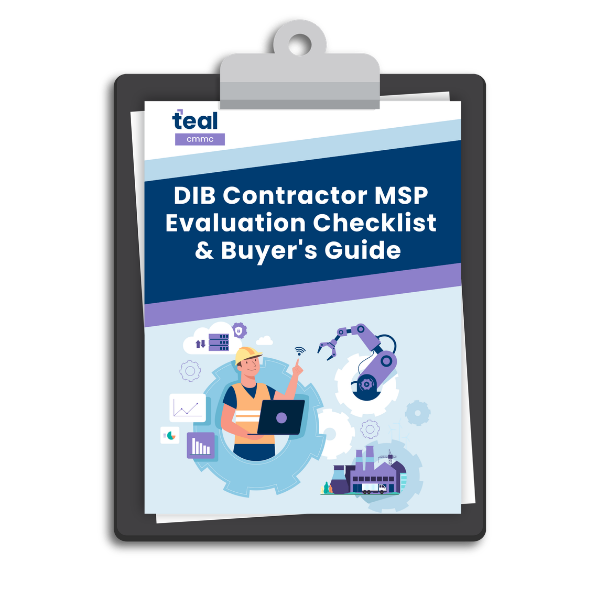
Not sure whether your MSP candidates can deliver on CMMC? This checklist walks DIB contractors through the questions that separate qualified managed IT providers from those figuring it out alongside you.
The Bottom Line on AI Adoption for DIB Executives
The contractors pulling ahead in GovCon right now are using AI. That part isn’t up for debate.
What separates them from the ones who get hurt is the order in which they made their decisions. Adoption first with governance second is a pattern that might look fine on the outside, but an assessor will find it. And under CMMC Level 2, that type of gap can cost you your contract eligibility.
The contractors who treat AI governance as part of their compliance program are the ones who get to keep both.