
Not every MSP selling CMMC readiness support has the delivery model to back it up. Some are building their process in real time – on your timeline and your budget. Here is how to tell the difference before it costs you your contracts.
Key Takeaways
- Most CMMC readiness failures trace back to ambiguous ownership between the contractor and their provider, not missing controls.
- With Level 2 C3PAO assessments becoming mandatory for contract awards on November 10, 2026, and most organizations needing three to nine months to reach assessment-ready, the margin for a slow start is already gone.
Table of Contents
What Happens When Your MSP isn't Ready for CMMC
A couple of weeks ago, we heard about a company pursuing CMMC Level 2 (later this year) that hired an MSP for consulting support. Two months later, though, they still didn’t have a roadmap. No documented scope. No gap analysis. All they received was a steady stream of “we’re almost ready” updates from the provider, but nothing to show the leadership team.
Unfortunately, that scenario is more common than it should be. And there is no longer a “safe margin” for a slow start to the process – especially when you’re trying to grow your business.
2 Reasons Executives Find Themselves Behind on CMMC
1. The provider wasn't ready to begin with.
CMMC enforcement is still in its early stages, with the DoD phasing requirements into contracts since November 2025. That rollout gave many MSPs cover to market CMMC services before they had a repeatable delivery model in place. Some are still building their process while billing you for the learning curve.
“Selling CMMC services and having the operational infrastructure and knowledge to deliver them are different things,” says Reid Johnston, Teal CMMC cofounder and Chief Intelligent Transformation Officer. “The gap between those two shows up fast when a client has a tangible deadline.”
2. The relationship was never documented clearly enough.
This is a subtler – and more common – situation. Even a capable MSP creates compliance risk when the responsibilities are ambiguous. Most failures stem from unclear ownership between the contractor and their IT provider.
- Who is accountable for data classification?
- Who makes the call on a reportable incident?
- Who owns the POA&M?
If those questions don’t have documented answers, the gaps will surface during an assessment, not before it.
In a regulated environment, you can outsource the execution, but you cannot outsource the accountability.
What a Good CMMC Roadmap Looks Like
A roadmap technically begins with a kickoff call and a project plan. But nothing starts until scoping defines your CUI environment and a NIST 800-171 gap analysis establishes your baseline. Without an accurate scope, your remediation priorities, documentation requirements, and SSP structure are all built on unstable ground. The gap analysis produces your SPRS score, your POA&M, and the sequence that everything else follows.
For most mid-sized organizations, the path from gap analysis to assessment-ready takes three to nine months. Organizations with unclear CUI boundaries or weak documentation fall on the longer end. Time is the one variable you cannot recover once it is lost to a provider who does not know where to start.
Why a Tested Model Matters More Than An MSP’s Promises
An experienced IT partner does not design a new process for every engagement. They apply a proven, structured delivery model to your environment. One that has been tested against assessor expectations, refined through implementations, and documented well enough to give leadership teams consistent visibility into the progress being made.
That structure matters for a specific reason: CMMC assessors do not evaluate intent. They evaluate your evidence.
Your SSP, your POA&M, your documented controls…an assessor will either accept them or they won’t.
“A repeatable model is all about defensibility,” says Gar Whaley, Teal CMMC RP, cofounder and Chief Revenue Officer. “When an assessor walks in, they’re looking for consistency between your documentation, your configurations, and your controls. If your MSP was trying to figure things out as they went, that inconsistency is going to show up.”
Why Your IT Partner's Experience Matters
Not every MSP that holds CMMC credentials has been assessed against them. A provider that has achieved CMMC Level 2 certification – or is actively working through their own compliance journey – understands how controls are tested, what documentation passes a review, and where organizations most often fail before a C3PAO walks in.
When a partner has not lived through that process, the gaps tend to surface too late: unexpected POA&Ms, failed controls, and remediation costs that compress an already tight timeline. Teal was among the first 62 Cyber AB-approved Registered Provider Organizations in the country — reflecting early investment in the accreditation structure that governs how this work gets done.
DIB experience matters for a different reason. An MSP that regularly works with defense contractors understands how CUI moves through your environment and how to structure a compliance program that does not require a full rebuild every time you pursue new work.
How to Evaluate Your Current Approach
If you are already working with an MSP on CMMC, these four questions will tell you quickly whether the engagement is on track.
1. Do you have a documented scope and CUI boundary?
If your MSP has not produced a formal scoping document that identifies which of your systems would fall in scope under NIST SP 800-171 or CMMC Level 2, your roadmap has no foundation. Everything downstream — your SSP, your gap analysis, your remediation plan — depends on an accurate scope.
2. Have you completed a NIST 800-171 gap analysis with a scored SPRS baseline?
If your provider cannot show you a current SPRS score and a gap analysis tied to all 110 controls and their underlying assessment objectives, you do not have a roadmap. You have a placeholder.
3. Can your MSP provide a sample implementation timeline and resource plan?
Ask to see how they have structured CMMC engagements with other clients. A provider with a repeatable delivery model can show you one. If they cannot, your engagement may be the one they are learning on.
4. Do you have a documented shared responsibility matrix?
A qualified MSP maintains a current record of who owns what — data classification, incident declaration, policy management, audit evidence. If that document does not exist, or has never been reviewed against your CMMC scope, you are carrying risk you may not know about.
If you cannot answer yes to all four, that is worth a direct conversation with your current provider before your timeline gets any shorter. Some gaps can be corrected. Others signal a more fundamental mismatch between what your provider can deliver and what your CMMC program requires.
Either way, knowing where you stand is the first step.
If your evaluation raises questions about your current provider – or if you are preparing to select an MSP for the first time – use the guide below to identify candidates who can meet that standard.
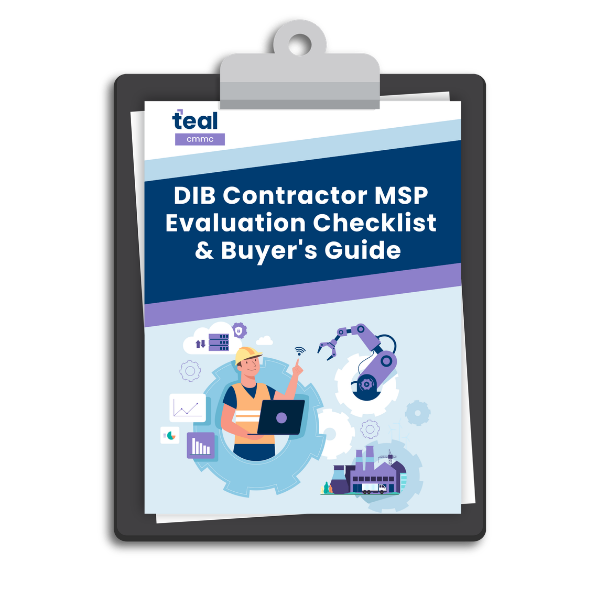
Not sure whether your MSP candidates can deliver on CMMC? This checklist walks DIB contractors through the questions that separate qualified managed IT providers from those figuring it out alongside you.
FAQ
What should a CMMC roadmap include?
It starts with formal CUI scoping, followed by a NIST 800-171 gap analysis that produces an SPRS score and a POA&M. Remediation sequencing, documentation development, and evidence collection follow that foundation.
What is a shared responsibility matrix and why does it matter for CMMC?
A shared responsibility matrix is a documented record of who owns specific compliance obligations between a contractor and their MSP – data classification, incident declaration, policy management, and audit evidence. Without one, gaps in ownership surface during an assessment rather than before it.
When do CMMC Level 2 third-party assessments become mandatory?
Phase 2 begins November 10, 2026, when C3PAO assessments become a mandatory condition of award for applicable DoD contracts. Given that preparation takes three to nine months, most contractors who have not started are already behind.